Thursday, May 17, 2012

This Semester is... FINAL!

All semester long, we've been playing this clip after someone's shot got finaled in dailies. So, in that spirit, I want to commend the entire crew for this semester's work and declare this semester FINALED!


Crew, thanks for all your hard work this semester. This project would not be where it is without each of you! To those of you that are leaving, we wish you well and would gladly have you back, so in that spirit, I have this for you:


And for those of you staying on board for the summer, rest up and recharge your batteries, because when we get back... well, I'll let Europe tell you:


Either way, happy summer, everyone!!!

Monday, May 14, 2012

Keep Calm And Carry On


Production has a tendency to get crazy from time to time. You just got to keep the faith and do as the British did. To everyone on the "Just Looking" crew, and to anyone who's going through finals and reading this, good luck with finishing the semester strong!

Tuesday, May 1, 2012

Being Versus Doing: A Happy Artist Is A Productive Artist

West and myself signed up for this class in the Acting Department this semester, ACT 620 - 01: MS: Movement: The Alexander Technique. The class is taught by Constance Clare-Newman, who is fantastic, and focuses on learning the specific Alexander techniques that actors use to optimize movement and voice.  The class has been one that has give me more than I could've ask for. Not only have I learned how to see and approach movement, posture, and voice in new ways, but I've been able to keep my focus better and keep my cool more in HIGH stress situations.


Part of our work for the class was to do a book report on a book relevant to the Alexander technique. I, by fate, luck, or both, end up with this book:


"The Art of Effortless Living" by Ingrid Bacci has helped me personally in multiple ways, but I never thought it would help me with directing the way it has. 


WARNING: This is an over simplification of the book and I highly recommend it.


The book describes that so many of life's conflicts come from us being obsessed with "doing" versus "being". A good football metaphor for this concept is being focused on running into the endzone before you've caught the ball.  If player is too focused on the future goal he's trying to achieve, it jeopardize what he is currently doing. On the flip side, if the player stays in his body and in the moment, he'll have a greater ability to adapt and actually realize his goal. And if the player is actually enjoying him or herself, they can perform to such a high level, they make it look easy, or effortless.


That's where the book instantly change me as a director. In dailies, I decided to not focus on results or deadlines. Instead, I shift my focus to my artists' state of being. Instead of saying things like "Can you get that done?" I would say things like "How's it going with this shot?" and "You feeling good about this?" The results from this approach were visible within one week. Dailies, the week after I started talking to my animators like this, were awesome. The quality of everyone's work jumped dramatically! I could tell they were enjoying themselves and taking ownership of their shots. I have been fully convinced that a happy artist is a productive artist, and my job as a director now is to keep my artist happy and feeling good about what they do. 

Sunday, April 22, 2012

The Animation Collaborative


This production would like to take a moment to thank the Animation Collaborative. Located in Emeryville, California, across the street from Pixar, The Animation Collaborative is an amazing new animation school (http://www.animationcollaborative.com/index.html). Five of our animators just finished taking the Animation Demo class with Mike Makarewicz this last winter session, and the things we learned didn't just benefit the animators who attended the class, but helped improve the animation quality on the whole film. That being said, "Just Looking" would like to show our support and highly recommend The Animation Collaborative.

Tuesday, April 3, 2012

Music


Listening to the music while animating.

I usually listen to the music while I am animating ( I'm sorry I know I shouldn't...) BUT one thing I found it interesting was that music (especially Jazz music) has a lot of patterns and rhythms, which seems to be similar to the timing in animation. It sounds funny but sometimes I get interesting timing from the music. Actually, me and Sean had talked about the relationship between music and animation before. I think there are a lot of things in common music and animation in terms of timing.

Coincidentally, Tom was explaining "Who is the Star?"(it is I think all about making contrast) in the dailies last week. I think music is one of the ways to think about it more. You may be surprised (or have already known) there's a tons of interesting patterns and accent in music.

so....Don't listen to the music while animating, focus!!

haha

Thursday, March 29, 2012

Be Vulnerable

As artists, we are constantly looking at each others work, giving critiques, and receiving critiques, which can sometimes be difficult and painful to hear. We spend so much time and effort on our work, that when we receive critiques, we have a natural reaction to defend ourselves and our work. But if we can suppress that urge to defend ourselves, and let ourselves be vulnerable, be open to what others are saying, and know that they are not trying to tear you down, but to help build you up, you will be on your way to becoming a better artist.

That's what we are all doing here right? Striving to be better, to do better, to grow and learn as men and women. If everyone is working towards the same goal of becoming better, and if you can let yourself be open and vulnerable when you are receiving a critique, there is no telling how much you will be able to grow and learn.

Tuesday, March 27, 2012

Layers


I know some the animators started using layered approach, I think it's really fast and efficient way to animate THEN why not using layers?

Our character rigs are really heavy and really hard to play in real time 24 fps unless hit playblast. I used to do that all the time, but think about how long we waste just waiting for letting computer do their jobs.

So I put everything in layers.

I put all the clothes, body and hands in a layer when I am working on facial. I put legs or any other body parts in a layer when they are not showing in the main camera. I hide Catherine when I am working on William. I usually make several layers depending on where I am working on then. so now I can play my shot by 24 fps(or at least look like). Of course, there are several situations that we can not avoid to deal with heavy stuff but at least I usually try to make it faster. Faster means I can try different ways more, and it means quality to me. Work efficiently, quality and sleep well.

Friday, March 23, 2012

Animating William


Start with head, hands or facial expression not ROOT

I don't know if this works for everyone but I came up with some tips for animating William since after I learned layered approach. What I found it the most interesting thing was to start with the BIG movement, and which is kind of interesting for animating the particular type of character like William. He is really stiff, and spine is aligned pretty much all the time, it seems to mean the biggest movement is not ROOT but maybe head, hands or even facial expression sometimes look bigger.

Whenever I was asked "What is the biggest movement?" "Which part of the body does start moving first?", I tended to say ROOT even before I think about it. I think this is one of the reasons why animating William is so difficult (at least to me). It's easy to be off model if William moves his spine as we move usually. 

So I tried to start with big ones not ROOT as I used to do all the time. There are a lot of different approaches and personal preferences, so I don't know if this works to everyone, but anyway, it works to me to avoid moving the spine too much.

Tuesday, March 20, 2012

Operation Fail-Safe! (Finding the right workflow)


When working with many artists, the relevance of a streamlined pipeline is extremely important. I've spent many hours researching and developing lighting workflows so that even the "entry level" lighter is able to light and extract render passes with minimal effort on our film.

When the film first commenced, I wanted to use RenderMan due to its certain caveats. But due to my own lack of RenderMan knowledge and the availability of people who have that knowledge, I decided to use Mental Ray. After starting, I realized that even though I know how to create and extract the passes necessary for compositing, maybe others wouldn't and maybe it wasn't even necessary to do all that work by hand. Upon further thought, I remembered that V-Ray is able to render all the necessary passes at the click of a few buttons. Upon that thought I took 2 days and converted all my Mental Ray shaders to V-Ray shaders. There was only one problem at this point. And that was the "artistic tweak-ability". I was finding it very hard to get away from that "V-Ray" look... especially with skin. So again I dug a bit more into the cave of internet research wonders. To be honest, I started to feel like Alice tumbling down the rabbit hole, thinking to myself "what am I going to do?". A few days later, I stumbled upon a phenomenal shader pack written by Ledin Pavel (aka Puppet) called puppet shaders. These shaders are extremely useful and are capable of rendering out to passes just like the V-Ray nodes. So yet again, I took a few more days and converted all my old Mental Ray shaders to puppet's shaders. After I finished and completed some more "tests", I realized that I had made a great decision and that all the research was well worth it.

Thursday, March 15, 2012

Importance of Planning

Our team has been learning a lot about animation this year, especially how to animate clean and quick in Maya. But knowing how to animate clean and quick isn't enough to get you all the way there. I have found that planning, knowing what you're going to do before you even touch the computer, is key. For some people thumbnailing their acting beats works best, while others like to shoot reference and study their timing, posing and acting choices, picking and choosing what works and what doesn't work. Which ever way helps you visualize your animation before you start in the computer, go for it. The important part is that you take the time to think before you act, that way you won't get lost in between planning and polish.

Monday, March 12, 2012

Fresh Blood

We've had some amazing new crew members join the team this semester. After being almost two years into this project, it's easy to be fatigued with the film. Fortunately, the new flesh blood, with their fresh eyes and enthusiasm, has proven to remedy that. But between the lack of sunlight and the new, fond taste for "fresh blood", can't help but think we're starting to turn into this guy.


Animation is in full swing, so posts maybe light for a while, but we're hoping to share some stuff soon!

Wednesday, February 22, 2012

Leveling Up

A group of us animators on the film are about half way through our Demo Class with Mike Makarewicz, at the Animation Collaborative, and our animation skills are leveling up like we're Goku, from Dragonball Z, training in 100x gravity. Our knowledge on animating in the computer has increased so much, that when we "shop talk" on the project now, it feels like this:


Iron sharpens iron. Man sharpens man.

Also, I apologies for the lack of posts for the past few months, but there has been A LOT going on on the production. We've been working on somethings that we will be sharing on here soon...

Wednesday, December 7, 2011

Character is King

Our team went down to LA for CTN last month and had an amazing time. We met some of the best animators including Doug Sweetland and Andreas Deja. They had some great wisdom to share, first they were talking about what its like to work on large teams with different types of people. That it's very important to work well together, to remember that everyone is working towards the same goal, to produce high quality animation. Then finally they talked about character, whether it be the characters in your film or the people you work with, character is king. As animators we must be able to balance the professional, and the artistic parts of our job, while working together as a team.

Saturday, November 12, 2011

The Thinking Character

I remember one day Tom told us in the dailies, "This character does not look like he's acting. He looks alive". I think the difference between "acting" and "alive" is all about "what the character is thinking". If the character looks like they're acting, then maybe the character is thinking about his performance (which sometimes works, for example, a shot with a cocky actor acting in cheesy way on a stage). All the movement and action should have a reason. Think about the thought process and show it through the characters. I just found good article about this by John Lasseter.


THE THINKING CHARACTER
When animating characters, every movement, every action must exist for a reason. If a character were to move about in a series of unrelated actions, it would seem obvious that the animator was moving it, not the character itself. All the movements and actions of a character are the result of its thought process. In creating a "thinking character," the animator gives life to the character by connecting its actions with a thought process. Walt Disney said, "In most instances, the driving forces behind the action is the mood, the personality, the attitude of the character—or all three. Therefore, the mind is the pilot. We think of things before the body does them."
To convey the idea that the thoughts of a character are driving its actions, a simple trick is in the anticipation; always lead with the eyes or the head. If the character has eyes, the eyes should move first, locking the focus of its action a few frames before the head. The head should move next, followed a few frames later by his body and the main action. The eyes of a character are the windows to its thoughts; the character’s thoughts are conveyed throught the actions of its eyes.
If the character has no eyes, such as an inanimate object like a Luxo lamp, it is even more important to lead with the head. The number of frames to lead the eyes and head depends on how much thought precedes the main action. The animator must first understand a character’s thought process for any given action. Consider a character wanting to snatch some cheese from a mouse trap; the eyes will lead the snatch by quite a bit because this is a big decision. The character needs time to think, "...Hmm...This looks tricky, is this cheese really worth it or is it just processed American cheese food?...Oh what the heck...," he decides, and snatches the cheese.
Conversely, if the action is a character ducking to miss a low flying sheep, the anticipation of the eyes leading the action should be just a couple of frames. "What the...," and the next thing, he is spitting wool out of his mouth.
The only time that the eyes or head would not lead the action would be when an external force is driving the character’s movements, as opposed to his thought process. For example, if that character was hit in the back by the low flying sheep, the force of the impact would cause the body to move first, snapping the head back and dragging it behind the main action of the body.


Monday, November 7, 2011

Tell 'em What You Told 'em

I really like when I watch movies and television programs that have messages that apply to animation. The one that helped me most recently was from the movie Seven Pounds with Will Smith, in which he is explaining a type of presentation to a company.
He says that you must be clear and:

          Tell your audience what you’re going to tell them
          Tell them
          Then tell them what you told them

This presentation technique reminds me of anticipation, the animation principle that we need to show the audience that something is about to happen. Then it happens and they can follow it because they saw it coming and were ready for it.

Another one of these messages I found in Futurama, in the episode Godfellas (S4_E8), when a race of tiny people worship Bender as their God. Bender tries to help them, and accidentally kills them, he tries not helping them and they end up killing each other. Then Bender runs into the real God, and he tells Bender “Being God isn't easy. If you do too much, people get dependent on you. And if you do nothing, they lose hope. You have to use a light touch.”  God then goes on to say,

”When you do things right, people won't be sure you've done anything at all.” 

This is the statement that stuck with me. When I think about animation this way, about how we are trying to create the illusion of life, that when we do our jobs right, the animator's hands will go unseen as the characters live out their lives on screen.

Friday, November 4, 2011

Character Consistency


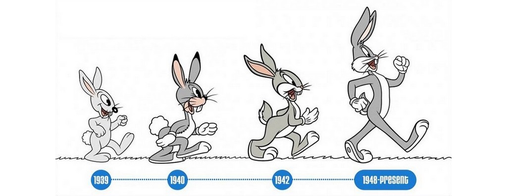
Same actor, different animators, different characters. We realized we were all animating the same character this week, but our performances were dividing our lead into different characters. Each performance had strong acting and good animation, but they weren't the same character. So this week we're aiming to, instead of one of us animate Tex Avery's Bugs, another of us animate Bob Clampett's Bugs,  and so on, we're all just gonna try to animate Chuck Jones' Bugs.

Friday, October 21, 2011

KEEP IT SIMPLE


I've heard this so many times in my animation life. Lately, I have been hearing it during my critiques, "Keep it simple." I always want my animation to look really great, but the really good ones are really simple as well. It seems I had a tendency to put so many things in one shot, and it turned out "too complex". Simple animation is not easier, actually it is difficult because we need to tell a story within the poses. Tom us "Simplicity rules all." Let's seek for quality and simplicity in animation.

Thursday, October 20, 2011

Together Everyone Achieves More


As Sean discussed in his last post, being the crew on a film is very much like being the crew on a ship. We have grown closer and stronger as a crew as we muscle through each of these storms. One of the things that is great about our crew is that we all come from different backgrounds, and we have different strengths, we have different specialties, which makes us stronger as a whole.

I myself studied Fine Art and Computer Animation in undergrad, where I made a short film by myself. Sean has been studying hand drawn animation since high school, and then went on to continue his education at Cal Arts, where he made several short films. Justin studied Computer Graphics as a generalist in his undergrad, and has now moved onto specialize in Texturing and Lighting. Ryo studied Media Science in college in Tokyo.  Moos worked in a small production company working on motion graphics for commercials and music videos. So we come from many different backgrounds and we have different strengths, and the great thing about working together on this film is that we all want to share our knowledge with each other, so that we can all become better artists. 

One of the first times that this crossover between backgrounds happened was when we started to work on the mods for our characters. Sean with his background in hand drawn drew the turnarounds of our characters. Justin with his technical knowledge of Maya started to test out the process for modding “Morphy,” after which he showed the process to me.  With my background in modeling in Maya, I took both Sean’s turnarounds and Justin’s modding process and started to create our characters in 3D. I worked for a long time modeling the meshes to get them to look the way we wanted them, and then Moos was brought onto the project and he helped me finish off the final steps of the modding process. 

While the modding process was going on, Sean was teaching us about hand drawn animation, about posing and timing, and what animation looks like when it’s done right. Which lead us to look to the past, and study the best hand drawn animators at Disney; Milt Kahl, Frank Thomas, Ollie Johnston, John Lounsbery, and Marc Davis. Studying the films on which they were the Directing Animators, such as, Sleeping Beauty, One Hundred and One Dalmatians, The Sword in the Stone, and The Jungle Book has been an eye opening experience for me as a 3D animator. Now we can start to understand how the Nine Old Men did what they did with hand drawn animation, and how we can learn from them, and use what we learn in our film today.

Saturday, October 15, 2011

Sailing Through Storms


I've really grown to like the simile "Being the crew on a film is like being the crew on a ship." When everyone does their job, the ship safely sails to land. The reason the ship comparison has really stuck with me is because just like a ship may have to sail through storms and rough waters, a film goes through conflicts and challenges in a similar fashion. You can see the storm brewing before you reach it, the water starts to get rocking, and before you know it, it's all-hands-on-deck! This week on the film, we had to weather another storm. The details of this week's storm are unimportant, but to sum it up, it was like a small hurricane that hit us out of no where. This storm stuck out to me from the others, though, because I noticed a change in us as a crew; we had grown and it was visible. In the past, we would panic, at times even turn on each other. But now, we stayed calm, cooperative, and ready to adapt. I'm really proud of the whole crew after this week, because it's clear to me now that we've all grown our "sea legs" and I'm more confident than ever that we'll make it to shore.

Friday, October 7, 2011

I'd like some TD madness with a side of help from my crew

Through-out the production, I have experienced many technical difficulties. Being the most technical of the crew, it is often my job to troubleshoot/solve these difficulties. Our first and largest issue to date was our characters... we have 14! At first I thought "I am just a texturing and lighting TD, what do I know about character modding?!?! Oh no!" haha, but I knew that my team needed me, and like any captain (co director in this case), I would rather go down with the ship then see my men drowning in the sea. After grasping a basic understanding of how previous mods were done on other projects (Norman in our case), I started studying the process a bit, doing a few tests, and then I was ready to move on. Next I had to get somewhat familiar with the standard Morpheous rig (Had some help with the animators/director on this due to my lack of animation control knowledge) Thanks Sean, West, and Ryo! The next step consisted of watching all of the videos that Josh Burton (Creator of Morpheous) posted about the rig on his website. These videos are a must watch if you want to use Morpheous to its full potential! Now it was time to move onto modeling. After some trial and error, I was finally ready to pass my knowledge onto my eagerly awaiting crew. The torch of modding lead was then passed onto Andrew West who at first struggled a bit, but is now a morphy modding maniac! West later teamed up with an outsider to the project named Daniel Moos who has recently became part of the Just Looking family, now working full time on the project. Between these two guys modding became unstoppable! So I feel the need to take this opportunity to thank the both of them for completing the majority of the character work. Thanks Guys!


After much thought about pipeline, I decided to switch over to using Vray for maya instead of Mental Ray for this project. This is due to the shear scale of this film. At 4 minutes and twenty seconds (80 shots), there is a good chance that there will be multiple lighters working on this film. Vray provides simple and intuitive render pass options that are simple to use and the fact that you don't have to litter your shading networks with gamma correction nodes is also a plus! Therefore if junior lighting artists who are looking to build there skill-sets and get some good looking work for their portfolios want to join the project, it wont be an issue to get them caught up on using render layers and passes. Also I have to admit that I am a sucker for Vray's photometric lighting! Hopefully they create a better workflow for volumetrics in the future though. As far as I am concerned, they are a bit unintuitive right now.


Characters are also being surfaced right now and will hopefully be completed in a month or so. The Vray SSS2 material seams slightly complicated after using the Mental Ray SSS_Skin material, but after many texture/color variation and many many button click, I will eventually figure it out. :)